
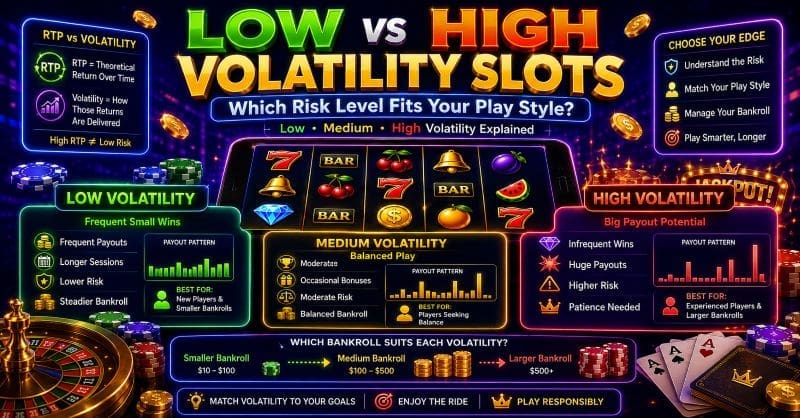
When looking at the differences in low and high-volatility slots, it is very important to realize that the reason for these differences cannot solely be attributed to luck. The main reason for these differences lies within the mathematics of each game. When understanding the volatility (variance) associated with a slot machine, players can begin to choose between low and high volatility slots based upon their bankrolls, levels of patience, and what they want from a gaming session. Ultimately, this is the entire basis for choosing the slot volatility that best fits you: how often you want to win, versus how large you want the win to be when it does happen.
What Is Slot Volatility and Why Does It Matter?
Slot volatility (also referred to as variance), is the term used to describe the level of risk present in a slot machine. Slot volatility does not pertain to whether a slot is rigged or hot/cold on a specific evening; rather, it refers to the inherent mathematical design of the game created by the game developer. In essence, volatility relates to how the overall payout of the slot machine is dispersed throughout thousands or millions of spins. Every slot volatility explanation begins with two characteristics: how often you win and how large those wins tend to be compared to your bet.
A major source of confusion surrounding volatility occurs when individuals fail to distinguish between volatility and RTP (return-to-player). RTP is defined as the percentage of all monies wagered on a slot machine that the game is designed to pay back over the course of its lifetime, which can extend for millions of spins. Although a slot may possess 97% RTP, this percentage does not relate to the predictability of short-term results.
Therefore, a player could potentially play a 97% RTP slot with extremely high volatility and run out of funds in fifteen minutes, or play a 94% RTP slot with low volatility and exit the gaming session after only an hour with little to no effect on their bankroll. High RTP is not indicative of how much you will receive in your pocket during the two hours you spend gambling. Rather, volatility dictates the manner in which your gaming session unfolds. Game developers commonly utilize some type of scale (often numbered 1-10, or rated 1-5 stars) to rate their slots’ volatility. The greater the number associated with the slot’s volatility rating, the more unpredictable the gameplay experience.

Low Volatility Slots: Relatively Stable Session Experience
Low-volatility slots provide players with a relatively consistent experience. Players can expect to win frequently, such as every third or fourth spin, and although the amount won will rarely exceed 2x-5x the player’s original wager, it provides a feeling of stability and relaxation during the gaming session. Examples of classic penny slots and many older three reel-style slots fall under this classification, as well as numerous contemporary titles developed by game developers as low-volatility options for novice players who wish to avoid experiencing significant declines in their balances early into a session.
However, due to lower winning combinations, capped winning limits are inherently included in low-volatility games. For instance, most low-volatility slots limit maximum winnings at approximately 500x-3,000x the initial bet. While this appears to be a sufficient limit prior to comparison with winning limits of high-volatility games, it is precisely that type of comparison that defines the purpose behind developing low-volatility games. They are intended for extended gaming sessions, not for chasing jackpots.
Low-volatility slots are ideal for players who have limited budgets and/or are attempting to complete wagering requirements using a no-deposit bonus or free-spins bonuses. I have observed multiple players exhaust free-spin bonuses offered on high-volatility slots in approximately ninety seconds due to excessive variance in their wagers. As such, players should focus on maintaining steady bankroll control, which represents the primary benefit associated with low-volatility games featuring frequent small-wins. Furthermore, low-volatility games are ideal for novice players seeking guidance regarding the bonus rounds and paytables associated with various slot machines.
High Volatility Slots: Infrequent Large Payouts and Increased Risk
Conversely, high-volatility slots feature infrequent payouts in exchange for providing opportunities to achieve extremely large payouts. Due to reduced frequency of wins, players may encounter prolonged periods of time (i.e., thirty to one hundred spins) without receiving even a minimal award. However, when a player finally achieves a winning combination or activates a bonus-round, the payout may be substantial. An exemplary representation of a game that utilizes this model includes Coin of Zeus; players may encounter lengthy intervals without achieving any awards; however, when an award is achieved, it can be considerable. Additionally, No Limit City’s Tombstone RIP exhibits similar behavior; while maximum possible wins exceeding 300,000x-stake exist; it is positioned at the upper-end of currently available high-volatility slots offering infrequently occurring large-payouts.
Many modern high-volatility slot titles emphasize maximum win potentials ranging from 10,000x-stake to 50,000x-stake or higher. Consequently, this increased potential exists primarily for attracting players seeking genuine life-altering experiences; whereas, low-volatility games are focused on generating an entertaining experience via frequent small-wins. To maximize success when engaging in high-volatility slots, players must develop bankrolls that enable them to absorb dozens of losing spins consecutively prior to receiving any form of return.
Therefore, high-volatility slots are not suitable for novice players utilizing their last remaining twenty dollars to test a slot title. Instead, high-volatility slots are designed for seasoned gamers who are aware of their ability to endure long periods without experiencing financial losses and/or are equipped with larger-than-average bankrolls.
Medium Volatility Slots: A Middle Ground
Positioned between low-volatility and high-volatility slots are medium-volatility slots. While neither as consistently rewarding nor as punishingly erratic as either end of the spectrum, medium-volatility slots provide rewards semi-frequently; thus preventing boredom resulting from overly frequent rewards associated with low-volatility slots while simultaneously reducing the likelihood of encountering prolonged dry-spells associated with high-volatility slots.
Maximum potential payouts for medium-volatility slots generally occur between 4000x-stake and 7000x-stake. Such maximum payouts offer moderate excitement without requiring an excessively large bankroll to sustain the volatility-induced fluctuations.
In summary, if you prefer watching your bankroll fluctuate moderately and appreciate occasional spikes generated by successful activation of a bonus round; yet lack sufficient bankroll size and/or patience for fifty consecutive blanks (losses), then medium-volatility slots represent your natural habitat. Many mainstream slot titles rely heavily upon medium-volatility settings as opposed to focusing upon either extreme.
Determining Which Slot Volatility Fits Your Gaming Style
Ultimately, determining which type of slot volatility fits your gaming style boils down to answering three basic questions:
1) How much money are you willing to risk per spin?
2) How many spins do you plan on playing?
3) What type of result would you require to leave satisfied at the conclusion of your gaming session?
Players planning on spending twenty minutes playing on their lunch breaks desire a significantly different experience than players who intend on dedicating an entire Saturday night to a designated gaming session with pre-determined bankrolls allocated specifically for the risks associated therewith. Three general indicators tend to guide you towards selecting either low-volatility or high-volatility slots based upon your gaming preferences:
Are you new to a particular slot title/game-type/genre or do you have limited resources/budget? In such cases low-volatility is recommended.
Do you desire a prolonged/gentle gaming experience where your bankroll fluctuates minimally? Again, low-volatility is suggested.
- Have you allocated funds specifically for pursuing a large-win and can afford to suffer extended periods without winning? In such instances high-volatility is preferred.
- Would you like the thrill/drama of experiencing a large-win more so than enjoying frequent small-wins? Also an indicator of high-volatility.
- Are you undecided and wish to experience elements of both worlds? Then use medium-volatility as your base-line.
Again, none of these distinctions refer to “good” vs “bad” volatility levels. Rather they represent choices made between matching your gaming preferences and budget constraints.
Locating Volatility Ratings in Slot Titles
While most legitimate game developers report their games’ respective volatilities; however you may need to search harder for such data. First try searching in-game-help files/payout screens. Numerous developers (e.g. NOLIMIT CITY & PLAYTECH) consistently label their games according to their respective volatility ratings. Many online casino review websites publish their own independently derived volatility indexes for popular titles if no such data existed within an in-game help file.
If you are unable to locate volatility ratings anywhere else; a useful alternative method for estimating volatility involves examining advertised max-win multipliers on loading screens/promotional materials. Generally speaking max-win multipliers under 3000x indicate low-volatility; max-win multipliers between 4000x-stake – 7000x-stake suggest medium-volatility; and any max-win multiplier exceeding 10000x indicates high-volatility.
Quick Answers Prior To Spinning
Are low-volatility games more consistent with respect to frequency of wins?
Yes; that represents virtually the sole design philosophy behind creating such games; namely providing players with frequent small-wins thereby keeping their balance closer aligned with the theoretical RTP of the game over a shorter duration.
Will high-volatility games produce more frequent wins than low-volatility games?
No; instead, they merely provide larger less predictable wins. RTP and volatility represent independent variables; therefore a game possessing high-volatility can exhibit identical RTP values as one exhibiting low-volatility; they differ exclusively in how they distribute returns over spins.
Can I attempt high-volatility games utilizing a limited budget?
Yes; technically possible; however doing so represents an unpleasant experience. More realistically you will deplete your bankroll sooner than desired prior to experiencing meaningful wins; therefore if you have limited funds allocate them wisely towards either low or medium-volatility options.
Should I use medium-volatility as my baseline since I am uncertain regarding my preference?
Honestly yes; it represents a fair compromise between both worlds; avoiding extremes characteristic of both low and high-volatility slots